Kingfishers at Landsberg am Lech: A High-Frequency Feeding Site
The photography trip to the kingfisher hide near Landsberg am Lech (Germany) in May 2027 turned out to be a very rewarding wildlife sessions. The hide is operated by a local fishery owner specializing in trout and other salmonids, and the hide is structured at a natural looking shallow pool that provide ideal hunting conditions for kingfishers. During my visit, it delivered exceptional activity levels.
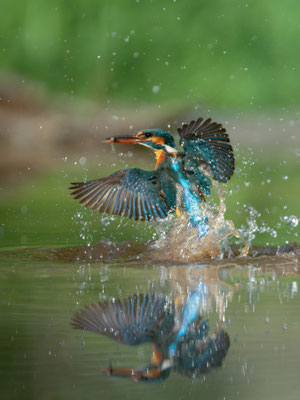
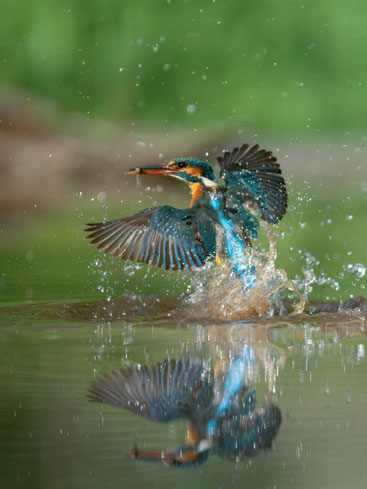
The main highlight was the presence of two breeding pairs of Common Kingfisher (Eisvogel). Both pairs were actively feeding their chicks, resulting in highly regular hunting behavior. On average, birds arrived approximately every 20 minutes, sometimes even more frequently during peak feeding periods in the early morning and late afternoon. This predictability created excellent opportunities for planned shots, although execution remained technically challenging.
The kingfishers did not consistently use the same perches or dive points. Instead, they alternated between multiple branches and entry angles into the water. This variability made flight photography a little tricky, especially when anticipating dive trajectories. Using the Nikon Z8, it proved highly effective to work with focus lock and a restricted focus area (delimiter) to avoid autofocus shifts. Most action shots were taken with the 200mm f/2 combined with a 1.4x teleconverter. For static portraits, particularly when birds paused briefly on perches, the 800mm f/6.3 was used.
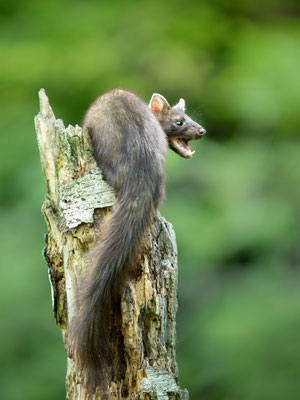
Beyond kingfishers, the hide offered additional mammal and reptile encounters. Two Eurasian Red Squirrels (Eichhörnchen) were active around the site, often approaching quite closely and providing good photographic opportunities. A particularly notable observation was an exceptionally photogenic European Pine Marten (Baummarder), which appeared for a longer time and allowed for a series of high-quality images. Around midday, multiple Grass Snakes (Ringelnattern) were observed hunting in the pool for young trouts and taking sun baths on a rock.
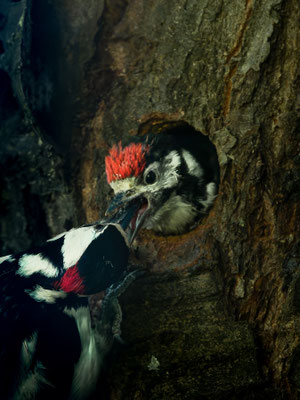
On the way to Landsberg, a stop near Kirchdorf am Inn provided an additional morning session focused on waterbirds and woodland species. A nesting site of Great Spotted Woodpecker (Buntspecht) was particularly active, with adults repeatedly feeding chicks at the cavity entrance. This allowed for a sequence of behavioral shots documenting feeding cycles. The wetland and surrounding habitats hosted a diverse range of bird species. Observations included Great Crested Grebe (Haubentaucher), Black-crowned Night Heron (Nachtreiher), Little Egret (Seidenreiher), Great Egret (Silberreiher), Common Kestrel (Turmfalke), Common Moorhen (Teichhuhn), Eurasian Coot (Blässhuhn), Northern Lapwing (Kiebitz), Black-headed Gull (Lachmöwe), Yellow-legged Gull (Mittelmeermöwe), Common Tern (Flussseeschwalbe), Stock Dove (Hohltaube), Eurasian Collared Dove (Türkentaube), Common Cuckoo (Kuckuck), Great Spotted Woodpecker (Buntspecht), Eurasian Skylark (Feldlerche), White Wagtail (Bachstelze), Common Nightingale (Nachtigall), Common Redstart (Gartenrotschwanz), Common Blackbird (Amsel), Song Thrush (Singdrossel), Savi’s Warbler (Rohrschwirl), Icterine Warbler (Gelbspötter), Great Reed Warbler (Drosselrohrsänger), Garden Warbler (Gartengrasmücke), Eurasian Blackcap (Mönchsgrasmücke), Common Chiffchaff (Zilpzalp), Spotted Flycatcher (Grauschnäpper), Eurasian Blue Tit (Blaumeise), Great Tit (Kohlmeise), Carrion Crow (Rabenkrähe), Common Starling (Star), Common Chaffinch (Buchfink), European Serin (Girlitz), European Greenfinch (Grünling), European Goldfinch (Stieglitz), and Hawfinch (Kernbeißer).