Three Winter Days with Golden Eagles in the Hohe Tauern near Mittersill
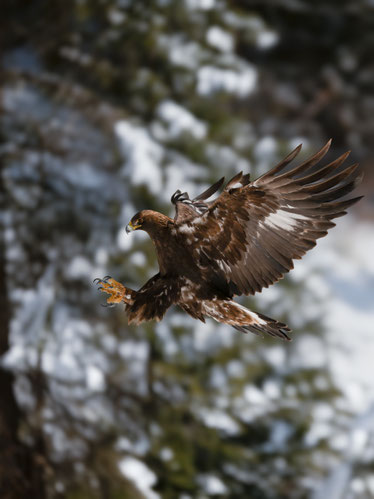
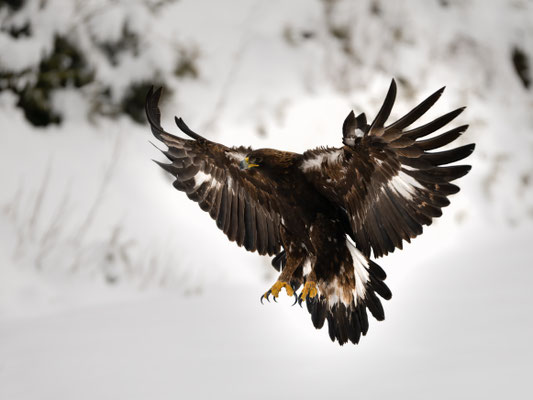
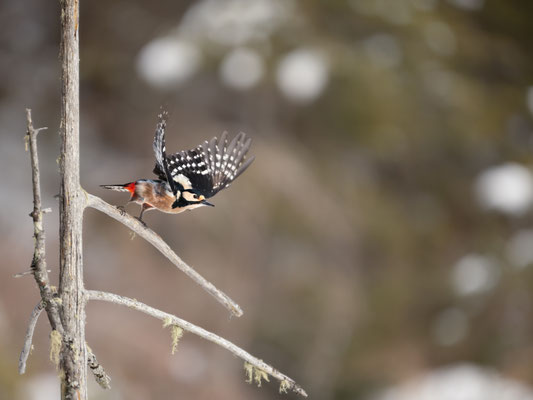
In February 2026 I spent three days in the snow-covered Hohe Tauern mountains above Mittersill, three days where patience and luck lay close together. The photography hide stood at about 1,800 meters altitude, weatherproof, heated, and equipped with large panoramic windows. From there, the view opened onto a narrow bend of a forest road, framed by deep-snowed spruces. On a small clearing, a few old dead trees stood between five and thirty meters away — perfect perches for birds of prey, should they decide to appear. The first day began lively. Much movement: jays, great spotted woodpeckers, nutcrackers, and crested tits — their constant coming and going added life to the charming winter landscape. By afternoon, the long-awaited subject appeared. Silently, a golden eagle glided into view from the right. It landed briefly on a stump, then on the clearing, where it fed on the laid-out cow udder. It stayed for about an hour — enough time for impressive shots. That day we saw one eagle, though in total there are thought to be seven in the area; generally, one pair is assumed per extended valley.
The second day brought heavy snowfall, poor visibility, and little activity — a test for camera and photographer alike. Around midday, the weather cleared briefly before new flakes swallowed everything again. Aside from the omnipresent jays, a juvenile goshawk appeared, still showing longitudinal instead of horizontal streaks. It came twice, and during the second visit lingered near the placed-out deer. Then two golden eagles appeared high in the sky — far off at first, but one eventually came closer. Its sudden approach was spectacular: it landed right in front of the hide, began to dig a deer out of the snow, and ate until full — so full that it had to climb the slope on foot before taking off with strong wingbeats to a nearby tree. It perched there for over an hour, until daylight faded.
On the third day, winter showed itself at its finest. Cold, clear air, blue skies, and sparkling snow, only the birds were silent. No calls, no wingbeats, no ravens, which were otherwise ever-present. I learned that one had ventured too close to a golden eagle days earlier and paid with its life. Since then, the ravens had avoided the territory. In the afternoon, life returned: a golden eagle appeared briefly, vanished, returned, and finally settled on the deer. Toward evening, things became exciting again, a fox crept along the forest road, shortly followed by a young eagle landing in the clearing. While it fed, a goshawk perched on a dead tree beside it, an intriguing juxtaposition of two raptors. But the eagle tolerated no company: with a swift beat of its mighty wings, it drove off the intruder, then launched into an impressive direct flight just past the hide, the perfect finale to three great days.
Photographically, the stay was demanding. Long waiting required full concentration, and when an eagle appeared, not a moment could be missed. Especially in heavy snowfall, autofocus occasionally failed, manual focusing was then essential. I used the Nikon Z8 with the Z 800 mm f/6.3 for portraits, complemented by the bright 200 mm f/2 with 1.4× teleconverter and FTZ II adapter. I can highly recommend Wildfoto Schwab for anyone interested in wildlife photography in the Tauern region.