
Betta macrostoma - Breeding report
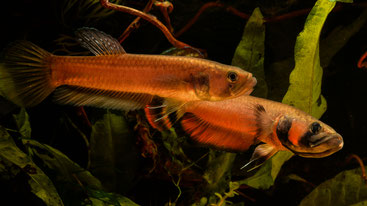
The species was first described by Regan in 1910 and occurs in the border region of Sarawak/Brunei. Since sufficient information about the species can be found in the literature, I will not go into further detail about its biotope conditions, etc. Instead, I will focus on my own experiences regarding its care and breeding.
For targeted breeding, I use a species-only tank with a base area of 60 × 40 cm. Only a single pair lives in this tank. My breeding pair comes from Marudi/Sarawak, and I assume they are already captive-bred.

I use 100% reverse osmosis water, and the conductivity in the tank is about 50 µS/cm, so there is a slight increase in hardness in the aquarium. Water changes are done weekly at around 30%. The pH is about 4.5, and small pieces of white peat sod are sufficient for acidification. These remain in the tank to stabilize the conditions. Since, given our living conditions, temperatures in summer rise to around 30 °C, I decided to use an external in-line chiller from Hailea. Such devices are also used for keeping cold-water animals (axolotls, etc.). To optimize cooling, I insulated some of the side panes and the filter hoses for the external filter with insulating material. The target temperature is 24.5 °C. In addition to the external filter, I have installed a small internal UV filter in another spot. I also do not use any substrate (sand, etc.) in this tank; there are only many roots, oak leaves, and clay shelters, and in the non-visible rear area, large yogurt cups. The tank is planted with plenty of Java fern, Anubias, and water sprite at the surface.

My fish are simply gluttonous, and you have to be careful that they do not jump out of the tank when the cover is opened. They accept any kind of food (including granules), but I regularly use pre-killed mealworms in addition to various other types of food. This is intended to help the male get through the mouthbrooding phase more easily. After two failed attempts – the male always swallowed the brood – it worked on the third attempt after about 20 days. It is not necessary to separate the juveniles from the parent fish. So far, I have not noticed any losses. The juveniles immediately accept Artemia and also dry food such as artificial plankton. In the meantime (4 August 2018), it has certainly been 2 weeks already – I have moved the juveniles to a 60-liter tank. The male had started mouthbrooding again, and a “stacked brood” is possible, if at all, only with considerable losses. In any case, the juveniles are now kept in reverse osmosis water without cooling (meaning the tank is at 27–29 °C in summer), and it works well. I only make sure to do a weekly water change of about 40–50%. The tank also has no substrate and is slightly acidified with peat. A UV-C unit is not in operation.