
Rasbora cf. patrickyapi - Breeding report
The genus Rasbora is one of the most diverse groups of small Southeast Asian cypriniform fishes, with a distribution extending from the Indian subcontinent to the Philippines and a particular centre of diversity in Borneo. Its taxonomy remains dynamic, with new species still being described in recent years, including Rasbora marinae Tan & Kottelat, 2020, while broader phylogeographic work continues to refine understanding of diversification patterns within Sundaland rasborines.
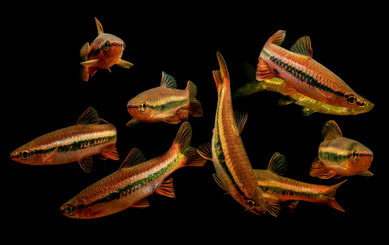
Rasbora patrickyapi was described by Tan in 2009 from central Kalimantan, Borneo, and is known from the Katingan and Kahayan river basins. According to FishBase, the species inhabits shallow, slow-flowing swampy habitats associated with blackwater systems in lowland peat swamps and degraded heath forest. The picture shows the "true" patrickyapi.
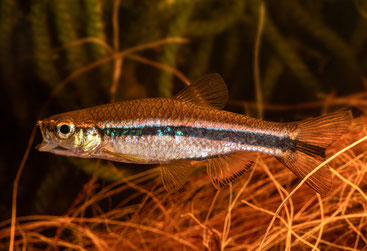
At the time when the fish first entered the ornamental trade, the species had not yet been formally described. The fish, encountered as bycatch together with Rasbora kalochroma, first drew attention through a Singapore-based ornamental fish exporter, and was later recognized as a distinct taxon by Tan. Records subsequently attributed to Rasbora cf. patrickyapi from Belitung and Bangka raise interesting biogeographic questions, as these islands are separated from Borneo by marine barriers today. However, repeated sea-level lowstands during the Pleistocene exposed large parts of Sundaland and temporarily reconfigured drainage connectivity across the Sunda Shelf, making broader historical freshwater connections plausible even if they were not universally effective dispersal corridors for every lineage.
This biogeographic context is important because it offers a credible explanation for the occurrence of closely related forms of R. patrickyapi on Belitung. At the same time, recent large-scale work on Sundaland freshwater fishes suggests that palaeodrainage connectivity alone does not fully explain present-day distributions, and that habitat structure, geomorphology, and lineage-specific dispersal limits likely also played major roles. An initial attempt to obtain the species by direct import failed in 2020. In July 2021, however, a group of Rasbora patrickyapi was finally obtained from a local collector in the Palangka Raya region of Central Kalimantan, who sourced the fish from nearby habitats.
Several breeding attempts with spawning mops and overflow-style breeding aquaria were conducted with this first group, but none was successful. Nevertheless, the fish adapted well to long-term maintenance in a blackwater community aquarium together with Pseudomystus funebris and, at times, Rasbora kalochroma, where they proved highly attractive and rewarding display fish. Contrary to repeated reports of strong intraspecific aggression in this species, no such behaviour was observed in this group. Instead, the fish consistently displayed a healthy appetite and showed little interest in conspecific confrontation. In late autumn 2023, wholesalers again offered Rasbora patrickyapi from Borneo as well as Rasbora cf. patrickyapi from Belitung. Motivated by the possibility that the Belitung population might respond differently under captive conditions, a new breeding attempt was initiated with a group of ten relatively young fish acquired in late November 2023, measuring approximately 4 to 5 cm in length. Sexual dimorphism in these fish was subtle but recognizable. Males were somewhat smaller and displayed slightly stronger coloration than females. Very little published information is available on the Belitung population of Rasbora cf. patrickyapi, although these fish had apparently reached Europe once before, in November 2012. Particularly informative in this context is an Indonesian study on the fish community of the upper Sungai Kayu Besi in Belitung, based on field surveys conducted in March 2019 and published by Novianti, Kurniawan, and Syari in 2020, as cited in the source text provided by the author. [query]
According to that study, the relevant habitat consisted of a small stream approximately 2 m wide and up to 1 m deep, with slow current around 0.1 m/s. Water temperature was reported at 23 to 25°C, pH at 6, and dissolved oxygen at 7.1 to 7.4 mg/L; in the same sections, Trigonopoma pauciperforatum, Rasbora dorsiocellata, and Hemirhamphodon kapuasensis were frequently encountered, while Rasbora cephalotaenia was recorded farther upstream. [query]
Additional field observations from Belitung were made by Michael Lo during a visit in 2012. He documented Rasbora cf. patrickyapi photographically and reported finding the fish in clearwater conditions, while also noting that limited time prevented a broader survey of other nearby habitats. The newly acquired fish were first housed in a 100 cm clearwater aquarium at a conductivity of 40 µS/cm and a water temperature of about 23°C. After an acclimation period of approximately three weeks, the actual breeding aquarium was prepared around Christmas 2023. The breeding tank consisted of a 60 L wedge-shaped aquarium run with a moderate pump output of about 400 L/h. The substrate was composed of boiled but not leached black peat granules with a particle size of 2 to 3 mm, while coconut fibre and both floating and bottom-positioned spawning mops were provided as spawning media. A few days after the first juveniles were noticed, the hydrochemical conditions in the breeding tank were measured on 13 January 2024. Specific conductivity was 62 µS/cm, pH 5.03, water temperature 28.4°C, and dissolved oxygen 6.6 mg/L. The reverse-osmosis water used for water changes had a conductivity of 10 µS/cm. Measurements were obtained using a WTW Multi 3630 IDS equipped with TetraCon 925, SenTix 940, and FDO 925 IDS probes.
An additional laboratory analysis by Oceamo reported the following dissolved constituents in mg/L: potassium 6.8, sulfate 5.2, sodium 4.4, nitrate 2.9, iron 2.2, calcium 0.6, phosphate 0.35, magnesium 0.3, aluminium 0.15, and manganese 0.1. Total hardness was 0.2°dH and carbonate hardness 0.1°dKH.
Taken together, these values indicate extremely soft, acidic, weakly mineralized water, closely matching the ecological profile expected for peat-associated Southeast Asian blackwater fishes. The successful appearance of juveniles under these conditions suggests that very low hardness, acidic water chemistry, and a structurally complex spawning environment may be important factors in triggering reproduction in this taxon.