
Macropodus hongkongensis - Breeding report

This year, I kept a group of Macropodus hongkongensis on the balcony in a species-only tank during the hot months (June–September 2018). Macropodus hongkongensis, commonly known as the Hong Kong paradise fish, was only described in 2002 and is encountered less frequently in the trade than species such as M. spechti or M. opercularis. It is a labyrinth fish endemic to southern China, originally described from populations in Hong Kong, and inhabits lowland marshes, streams, and agricultural waters such as rice paddies, often in shallow areas with dense aquatic or marginal vegetation.
The balcony tank, filled with Vienna tap water (KH around 6–7), became heavily overgrown with floating plants and green algae. It received both direct sunlight and plenty of shade throughout the day, and I did not pay much attention to the setup during summer—essentially just feeding and carrying out a few moderate water changes. Today, I intended to move the fish back into an indoor tank, but the process took much longer than expected: there were huge numbers of juveniles—far more than I would dare to estimate, but certainly well over 100 individuals. Despite this high stocking density, there were still plenty of microorganisms in the balcony tank, and the adult fish apparently did not, or only rarely, prey on the fry.
In the meantime, I have transferred the juveniles—or at least as many as I could catch—into two rearing tanks. I was genuinely surprised how many fish were able to survive in such a relatively small setup without the targeted addition of starter foods such as infusoria. The juveniles are now, of course, being fed vinegar eels and canned plankton.
In terms of general biology, M. hongkongensis typically reaches around 6–8 cm in length and shows a dark grey to almost black body with contrasting reddish to orange fin markings, making it less gaudy but still very distinctive compared with the better-known paradise fish. Like its relatives, it possesses a labyrinth organ, allowing it to breathe atmospheric air and tolerate warm, oxygen-poor habitats. Males are strongly territorial and build bubble nests at the water surface, where they guard the eggs and larvae until the fry become free-swimming. In the wild, the species feeds mainly on insect larvae, small invertebrates, and fish fry, acting both as a small predator and as an indicator of intact freshwater wetlands. Although not yet formally assessed on the IUCN Red List, habitat degradation and collection for the aquarium trade are considered potential threats, and in parts of its range the species likely already meets criteria for a threatened category.
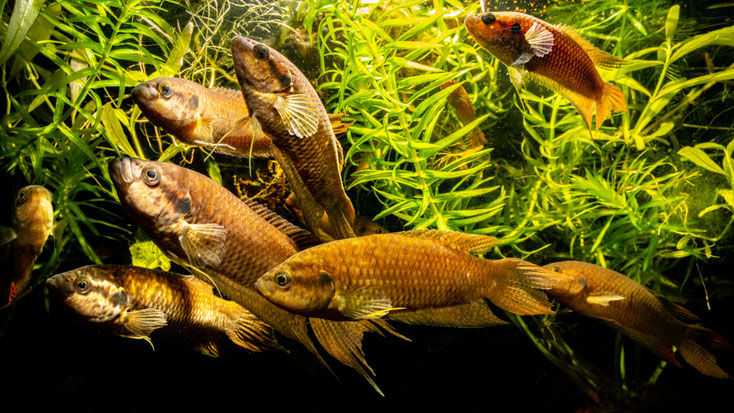
Group of Hong Kong paradise fish.
