
Rasbora lacrimula - Breeding Report
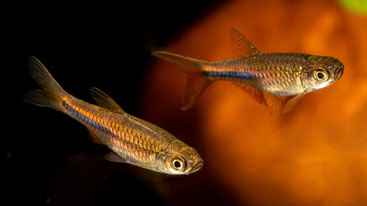
Rasbora lacrimula was scientifically described in 2009 and occurs in the lower drainage basin of the Mahakam River (specifically the Ulu Belayan drainage) in the province of East Kalimantan on the island of Borneo (Hadiaty & Kottelat, 2009). The fish inhabit small streams (2–3 m wide, about 1 m deep) with clear water and sandy substrates. However, low pH values of around 5 are reported for the type locality, which suggests the presence of some blackwater influence.
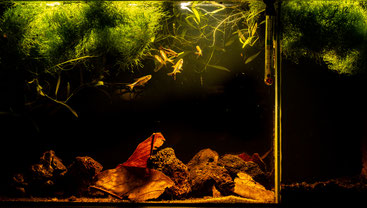
For breeding, I use a 60‑liter partitioned tank with 100% reverse osmosis water and peat granules as the substrate in the rearing section. This results in a stable pH of 4.5–5.5 in the tank. The planting consists of abundant Hygrophila polysperma and Riccia fluitans, and a spawning mop is also placed in the flow area. The temperature is kept constant at 27 °C.
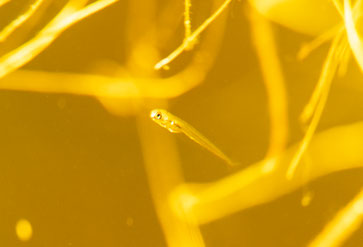
Six adult fish (two females) are kept in the tank and are initially well fed (live and decapsulated Artemia nauplii, microworms, Drosophila). After just a few days, the first eggs become visible, preferably adhering to the Hygrophila. A few days later, the first fry can be observed swimming freely in the rearing section of the partitioned tank. They are shy and tend to hide close to the substrate and among leaves.
As new fry appear daily, I now feed infusoria in the fry section and primarily live Artemia nauplii in the area with the adult fish. Enough live Artemia reach the fry section and are accepted as soon as the juveniles are large enough. To counteract the increased bacterial load from heavier feeding, I use a very low preventive dose of Baktopur, as well as Indian almond leaves to reduce the risk of fungal growth on the eggs. It is also worth noting that no cold water changes are carried out, yet the fish still spawn successfully.