
Trigonostigma somphongsi - Breeding Report
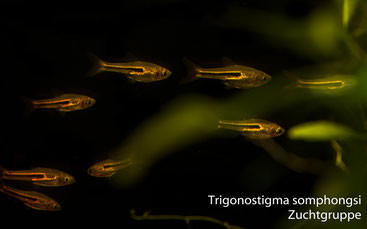
Trigonostigma somphongsi (formerly Rasbora somphongsi) has long been known in the aquarium hobby. According to Riehl & Baensch (2004), the species was first imported from Thailand by Werner in 1957 and shortly thereafter described by Meinken (1958). An interesting report by Aquarium Glaser (2015), a wholesaler that regularly documents imported species, notes that the original description did not include precise information about the type locality. Only in a later scientific publication was the region “southern Menam” (Thailand) specified.
Over the years, fewer and fewer specimens were imported due to habitat destruction. It is worth noting, however, that the species was successfully bred in captivity in the past. As a result of the presumed loss of its natural habitat (the Mae Khlong basin near Ratchaburi in central Thailand), the species was classified as “Critically Endangered” on the IUCN Red List by Vidthayanon in 2011. The fact that individual specimens continued to appear as bycatch in export shipments to Germany and Japan suggested that the species had not yet gone extinct (Aquarium Glaser, 2015).
In 2014, however, there was a positive surprise: Nidsaraporn et al. (2014) discovered a new population in flooded rice fields in the Bangpakong basin in Nakhon Nayok Province, central Thailand. This study is available online (see references). The fish migrate into flooded rice fields during the rainy season to reproduce and retreat to main water bodies during the dry season. Notably, water parameters in these flooded areas fluctuate considerably: the authors report pH values ranging from 3.81 to 7.98 and hardness (as CaCO₃) between 35 and 202 mg/l, while temperature varies only between 31 and 33.5 °C.
For biotope aquarists, it is also interesting that during the dry season, species such as Trichopsis vittata and Boraras urophthalmoides were found in remaining puddles within the rice fields. During the rainy season, when flooding occurs from September to November, T. somphongsi was observed migrating together with Rasbora borapetensis, Amblypharyngodon chulabhornae, and Boraras urophthalmoides. At present, the species is again being imported regularly, and I have also seen stock lists that include captive-bred specimens.
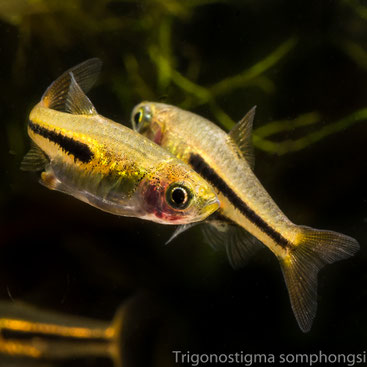
Externally, females differ from males in that they are significantly more robust and larger (up to about 3 cm). Males are smaller and more slender, but also more intensely colored. Keeping these fish is generally not particularly difficult—any species that tolerates such fluctuations in water parameters is likely quite hardy. For breeding, however, very soft water is still recommended; in my case, I use reverse osmosis–treated tap water with KH 0 and a low pH.
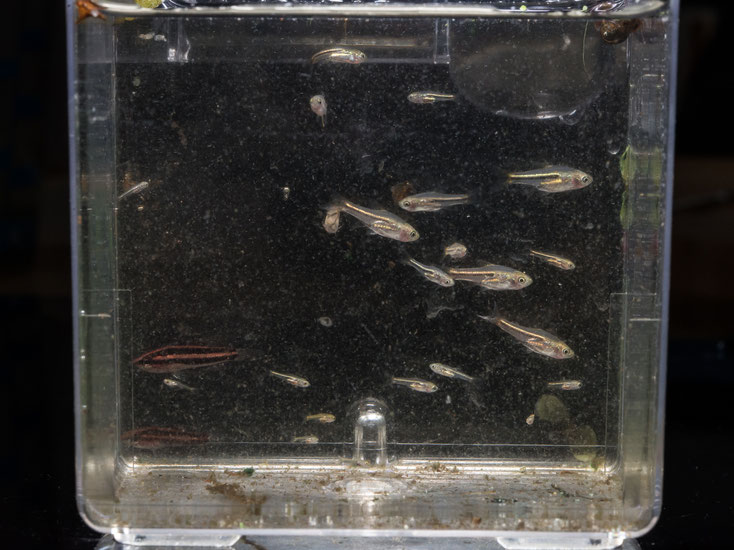
To create blackwater conditions, I use pieces of white peat, which I place directly into the tank. This allows me to achieve pH values around 4. The effect of the peat lasts for months, and it also serves as substrate in the aquarium. For breeding T. somphongsi in a continuous setup, I use a 60‑liter V-shaped tank (also called a wedge tank) (see Figure 2). A breeding group of 11 individuals, including several males and females, is kept in it. Since the adults prey on their offspring, I chose this V-tank method. Due to the current, the fry collect in the separate rearing section divided by the wedge.
The main tank is substrate-free except for peat pieces and some leaves (oak and Indian almond). I have planted Hygrophila polysperma in small clay pots, as it is important to know that the fish spawn on the undersides of leaves. In the fry section, besides Salvinia natans, there is also Java moss. To actually induce spawning, several water changes per week are essential. These should not be too small in volume—I change about 30–40% twice a week, though a breeder from Scotland recently recommended up to 70%. It is also important to use cooler water to temporarily lower the temperature by about 3°C. Afterward, the fish should be fed generously with Artemia, Moina, and vinegar eels, although they will also accept dry food. For the fry, I initially use liquid starter food.
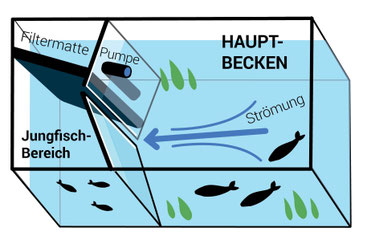
For breeding T. somphongsi in a continuous setup, I use a 60‑liter V-shaped tank (also called a wedge tank) (see figure). A breeding group of 11 individuals, including several males and females, is kept in it. Since the adults prey on their offspring, I chose this V-tank method. Due to the current, the fry collect in the separate rearing section divided by the wedge.
The main tank is substrate-free except for peat pieces and some leaves (oak and Indian almond). I have planted Hygrophila polysperma in small clay pots, as it is important to know that the fish spawn on the undersides of leaves. In the fry section, besides Salvinia natans, there is also Java moss.
To actually induce spawning, several water changes per week are essential. These should not be too small in volume—I change about 30–40% twice a week, though a breeder from Scotland recently recommended up to 70%. It is also important to use cooler water to temporarily lower the temperature by about 3 °C. Afterward, the fish should be fed generously with Artemia, Moina, and vinegar eels, although they will also accept dry food. For the fry, I initially use liquid starter food.
References
Vidthayanon, C. (2011): Trigonostigma somphongsi. The IUCN Red List of Threatened Species 2011. Available at: http://dx.doi.org/10.2305/IUCN.UK.2011-1.RLTS.T187886A8638137.en (accessed October 2, 2017).
Riehl, R. & Baensch, H. A. (2004): Aquarienatlas, Volume 3. Mergus Verlag, p. 260.
Nidsaraporn et al. (2014): The first record of Trigonostigma somphongsi (Meinken, 1958), a critically endangered species, in its natural habitat in Thailand (Cypriniformes: Cyprinidae). Available at: http://www.biodiversityjournal.com/pdf/5(4)_471-474.pdf (accessed October 2, 2017).
Aquarium Glaser (2015): Trigonostigma somphongsi. Available at: http://www.aquariumglaser.de/fischarchiv/trigonostigma_somphongsi_de/ (accessed October 2, 2017).